


A Shore Bet
Long Branch typified New Jersey’s fast disappearing seaside charm. It was renaissance or bust.
By Barbara Ballinger
Before New York’s Hamptons attracted wealthy homeowners and chic celebs, Long Branch, N.J., ranked as one of the country’s premier summer resorts with five miles of Jersey shoreline. Seven U.S. presidents vacationed there and attended services at an 1879 Episcopal church, which became known in their honor as the Church of the Presidents. Winslow Homer depicted its beach in his art.
The beach is still soft, white, and sandy, and meandering Victorian “cottages” with wide front porches still line leafy streets. But through the years, Long Branch lost luster as plane travel took vacationers farther from home. Investment in the city languished, and the gritty urban life—high crime, building vacancies, dwindling population, and tacky shops, particularly along the pier—stole away the charm of yesteryear. A fire in 1987 spelled the beginning of the end.
Civic leaders were determined to reverse the tide and asked Mayor Adam Schneider to help. “Everyone was skeptical because Long Branch had been through prior redevelopments. We took a different tact and developed a master plan before we hired a developer,” says Schneider, who took office in 1990. With input from architects and urban planners at Thompson Design Group in Boston, the private and public sectors envisioned a destination that maximized the oceanfront year-round.
A 28-acre stretch by the water would become a lively mixed-use complex with homes above shops and restaurants, hotels, green space, and ferry service to lower Manhattan. The centerpiece would be a new boardwalk and pier—hence the development’s name, Pier Village, minus the amusement park, which leaders felt wouldn’t fit the image desired.
To construct Pier Village, the leaders hired Applied Development Co. in Hoboken, N.J., which purchased 35 parcels of land between 1999 and 2001, and tweaked the plan. The firm decided that low-rise buildings would have mostly Victorian facades to evoke the past, but a few would be contemporary for a more evolved aesthetic, says president David Barry. His firm also suggested rental units rather than condos. “We felt condo owners would use them as second homes in warm weather, but renters would stay all year,” he says.
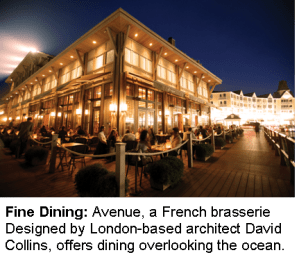
Other team members made additional key decisions. Architect Glenn Haydu of Minno &Wasko Architects & Planners in Lambertville, N.J., designed an oceanfront restaurant, Avenue, and a beach club with a rustic sustainable facade but big glass panes on the ocean side for views. Thompson principal Pratap Talwar and landscape architect Tom Bauer of Melillo + Bauer Associates in Manasquan, N.J., redesigned the scale of Ocean Avenue and added medians for a more residential approach into the development. They also massed buildings to capture ocean views, set aside a crescent-shaped green space for public activities, improved beach access, planted native grasses to catch pollutants, and installed dark-sky lighting with a historic look.
To date, 536 rental units have been built, with 90 percent of the 320 in Phase I and 70 percent of the 216 in Phase II leased. Monthly rents run from $1,285 to $4,100. Twenty-nine of the 32 retail units totaling 100,000 square feet are occupied, and a cutting-edge-style, 24-room boutique hotel, Bungalow, was set to open May 1. More than 500 permanent jobs have been created.
While the pier and ferry terminal have not yet been constructed, the City Council adopted in March a $1 million bond ordinance to fund planning. Phase 3, to start in spring 2010 once all plans are approved, is expected to add 200 apartments, 75 condos, 20,000 square feet of new retail, a 100-room hotel, and an oceanfront park.
Already, change is palpable. Restaurants like The Turning Point have become hubs even in winter. And the rental population isn’t comprised just of the anticipated young professionals but also boomers like management consultant Joe Raff, who grew up on the Jersey Shore and was looking for a self-contained, ocean community.
Last summer, more than 500,000 visited the beach, says Mayor Schneider. The equalized ratable base for Long Branch jumped to $6.5 billion this past January from $1.5 billion in 2001, according to the Long Branch Tax Assessor.
Pier Village is causing ripples beyond its shore. “It has spurred $20 million worth of public investment throughout the city,” Talwar says. The New Jersey District Council of the Urban Land Institute named Pier Village 2006 Project of the Year. Travel & Leisure magazine ranked it among the country’s “20 Great
American Beaches” in 2007.
[ the details ]
Pier Village is a mixed-use community in Long Branch, N.J., a city of 32,000 in Monmouth County. It is located two blocks from a train station with frequent service to New York 55 miles away and 45 miles from Newark Liberty International Airport. Phase I opened in 2006; all three phases are expected to be completed by 2011. For more information on Pier Village, visit www.piervillage.com.
SITE PLAN
Two main roads—Ocean Avenue and Ocean Boulevard—frame the development and parallel the new boardwalk and planned pier; new medians along Ocean Avenue calm traffic. A crescent-shaped, half-acre green space near the ocean known as Festival Plaza is used for concerts, outdoor movies, farmers markets, and other public activities.


 cahnroundup.com